
Healthcare organizations require competent medical billing software as a financial management solution. To maintain HIPAA compliance, an integrated electronic medical record (EMR) system must contain security and privacy measures. It covers operational activities like patient invoicing and insurance reimbursement. Each of the three operational categories, including running expenses, patient care costs, and patient billing, is critical for effective revenue cycle management.
These components are supervised by the unified electronic medical record (EMR) system. They have an impact on the amount of money collected and compensation, as well as the time it takes to process claims. In an uncertain environment, your healthcare company must efficiently pay supplier invoices and control expenses. It contributes to better performance. In this blog post, the term “healthcare accounting software” refers to specialized accounting software designed for medical practices. Additionally, it has an ERP for the entire organization that assists practices in evaluating and picking billing software programs to meet their particular needs.
Top 5 Healthcare Accounting Software for Modern Practices
Sage Intacct
Sage Intacct offers an industry-specific healthcare and hospital accounting solution as one of its cloud accounting software options. According to the AICPA, Sage Intacct accounting software is a smart choice. Aside from healthcare and hospital accounting, Sage Intacct provides software for nonprofit medical facilities.
Features
- HIPAA-compliant, using Advanced Audit Trail
- A dimensional general ledger for a learner’s chart of accounts
- Real-time financial reporting and dashboards with KPI data
- Accounts receivable and accounts payable
- Recognizing revenue in accordance with accounting principles
- Financial consolidation across several entities and currencies with inter-entity exclusions
- Integrated with third-party software.
QuickBooks Online
QuickBooks Online, cloud-based bookkeeping software for small businesses, has been upgraded to include third-party apps from the App Store. It offers healthcare accounting and financial automation.
Healthcare organizations can pay their workforce using QuickBooks Online’s optional payroll software. This financing healthcare software also offers an Accountant version, which allows CPAs to figure out their clients’ bookkeeping and retain records.
Features
- QuickBooks Online lacks HIPAA compliance and the advanced features of a high-cost EMR system widely used by medical practices.
- The inexpensive QuickBooks Online accounting software can be configured to perform a few back-office tasks. These chores included managing and tracking inventories.
However, it lacks the capability required to comply with HIPAA privacy regulations. It shouldn’t be used to submit personally sensitive information.
NetSuite ERP
NetSuite ERP is a cloud ERP system built for mid-sized or more substantial businesses in growth mode. The company delivers industry-specific healthcare accounting software and other ERP modules to the healthcare and life science industries.
Features
- HIPAA adherence for patient or client data privacy.
- Personalization for multiple healthcare or life sciences organizations.
- Role-permitted real-time dashboards for visibility.
- Internal controls, audit trails, and real-time reporting and analysis.
- Compatible with third-party healthcare accounting systems and add-on applications.
- Integrates with NetSuite CRM or Salesforce for customer relationship management.
Acumatica
Acumatica is a legitimate cloud ERP system that can be used as accounting and administrative software for businesses. It is used by healthcare companies, although there is no healthcare edition.
Features
- Modules for core, fixed assets, inventories, and advanced accounting
- Dashboards and real-time reports
- Multi-entity accounting and intercompany eliminations
- Data encryption and security
- Personalization
- Mobile application
- Smooth interaction with external software
Odoo
Odoo is a low-cost, modular accounting software and ERP system used by a wide range of enterprises. This application can be integrated with a third-party app solution even if it lacks internal finance management software. Odoo interfaces with third-party healthcare management software modules from the Indian software developer Pragmatic Techsoft, Pvt. Ltd.
Modules
Pragmatic Techsoft provides three modules for Odoo Healthcare Management.
- Hospital Information System (HIS)
- Health Information System
- Electronic Medical Record (EMR)
Features
- System for patient records for easy access
- Clinical management tools and hospital records
- Automation
Why Accounting Software for Healthcare Organizations Matters!
Healthcare facilities face particular financial and regulatory issues, making specialized accounting solutions essential in today’s world. Here are a few justifications:

Managing Complex Billing Systems
Provider organizations that generate revenue from NHS contracts, insurance claim payments, and private payments might use multiple systems and software applications. It allows them to efficiently manage the processes associated with the revenue streams and create efficiency within all financial departments.
The use of these systems and applications will allow provider organizations to identify billing errors, expedite claims processing, and maintain effective revenue integrity throughout all financial departments.
Necessity to Meet Compliance Requirements
The financial aspect of health care requires strict compliance with various legal standards. For example, HIPAA assures the protection of patient information. Additionally, it guarantees adherence to various tax and legal limitations specific to each healthcare provider.
Compliance features integrated into specialized accounting systems reduce the incidence of audits, penalties, and potential liability issues.
Integrated Practice Management
Electronic health records (EHRs) and account management systems are linked with medical accounting software. This offers better operational insight, real-time financial reporting, and easy billing, which conventional accounting software sometimes fails to offer. These links enable medical accountants to give more exact accounting operations and insights.
Detailed Expense Tracking
To remain productive, medical care organizations must carefully track all expenses, from professional salaries to medical supplies.
Doctors and practice managers can gain a better understanding of the financial health of different departments or services. This can be done by employing particular tools designed for comprehensive and accurate spending analysis.
Cash Inflows and Outflows Efficiently
Receiving insurance payouts could take months. A healthcare accounting system helps practices in more efficiently estimating cash flow via claims data, estimated reimbursements, and previous trends.
These particular tools are critical for preserving a medical practice’s financial health due to their ability to enable proactive financial planning and stability.
Customized Reporting
Internal management, government agencies, and insurers all require specific financial reporting from health care facilities. The adoption of advanced technology that generates healthcare-specific reports saves time and improves decision-making.
Enhance Patient Care
Medical finance software helps physicians and other medical staff to provide better patient care. This expedites the billing process by providing a variety of payment alternatives and automatically generating invoices.
Sometimes, excessive administrative labor may require the medical professionals to concentrate more on the patients.
Patient Billing and Payment Collection
Patient receivables and balances are more difficult to handle than most other sectors. With the use of automated reminders, payment plans, and patient portals, clinical accounting solutions decrease administrative difficulties. Additionally, it enhances the likelihood of payment.
Common Problems in the Healthcare Sectors
- The healthcare industry has multiple daily challenges, which can lead to poor patient care and medical service. Let us quickly go over the healthcare system’s flaws.
- Healthcare officials frequently require assistance with accurate and timely billing, which leads to income loss.
- Coping with the intricate claim settlements, each with its own set of regulations, requires help for the authorities.
- Hospitals and healthcare professionals must follow the healthcare insurance portability and Accountability Legislation to ensure patient records are safe.
- Keeping track of costs, revenue, and profits is an ongoing struggle for the healthcare business.
- Delayed bills and a lack of payment methods disrupt patient care.
- Due to variances in duties, schedules, and shifts, managing hospital personnel payrolls is challenging.
Modern medical accounting software addresses these concerns while also automating the system.
Must-Have Features of Healthcare Accounting Software by 2026
Selecting a medical practice’s accounting application is essential to the successful operation of the medical practice and, ultimately, the financial success of the practice.
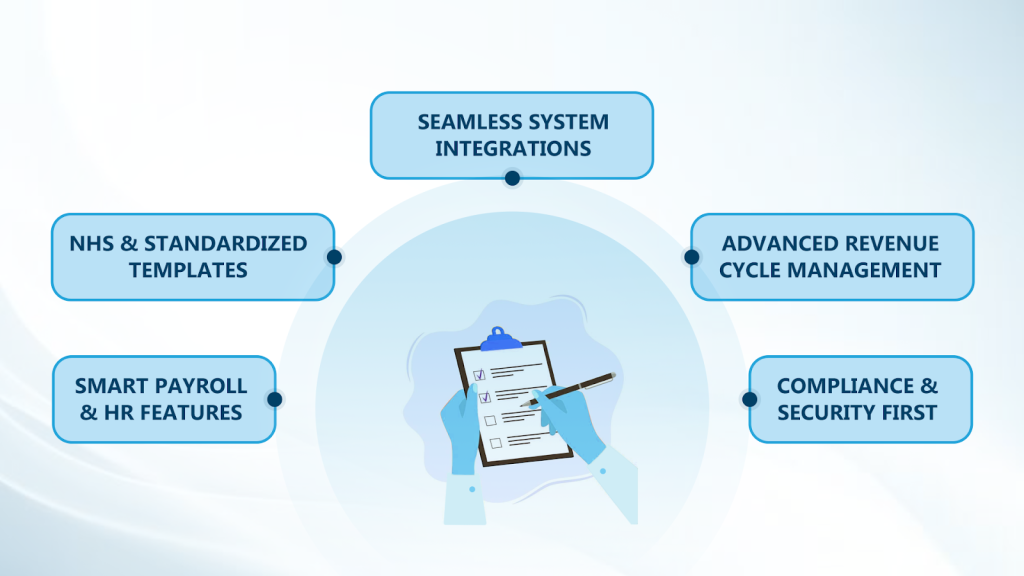
Integrating with Patient Management Systems
Medical accounting software and your patient management application must communicate with one another. Using both systems at the same time reduces the need to re-enter data. It ensures that all insurance claims, patient billing, and appointment scheduling are logged into your accounting software on time.
Data from both systems can be combined, providing a comprehensive view of a practice’s finances in relation to its patient activities. This means cutting down on errors and speeding up revenue collection.
Healthcare Specific Revenue Cycle Management
Opt for healthcare finance software that provides complete revenue cycle management. It includes automated claim filing, rejection management, pre-authorization, and insurer eligibility verification. These specific characteristics prevent revenue loss.
NHS-Approved Template Support
Use the above methodology to find an accounting software solution that integrates NHS templates. NHS templates help you to manage contracts successfully throughout the administration process and claim funding from NHS organizations. It also executes audits effectively by following demanding criteria connected to invoicing, reporting, and compliance.
The administrative burden will be much reduced when you incorporate NHS templates into your clinic. This decreases the possibility of error, which may lead to missing payments.
Security and Adherence
Patient safety and compliance must always come first. Adhering to the stringent rules governing the health care industry is essential. This ensures that the quality of service provided by your organization remains satisfactory.
Organizations in the health care sector are required to adhere to multiple standards, including those established by GAAP, IFRS, HIPAA, and other regulatory agencies.
All confidential patient and financial information is protected by employing a highly secure accounting solution. It offers peace of mind if there is a question about the protection of sensitive information.
Employee Payroll Management
Payroll management for medical practitioners is a challenging operation due to frequent changes in profit and tax needs over time. The payroll administration in accounting software automatically automates payment calculations, deductions, tax restrictions, and automatic deposits. It complies with labor standards and healthcare compensation policies.
OCloud Solutions efficiently tracks labor expenses and keeps precise employee payment records by integrating payroll and financial information.
Add-on Features for Healthcare Financial Software
Aside from NHS interaction and support, explore features like automated billing and detailed financial reporting. Ensures that monitoring of expenditures and secure data protection is simple. Cloud-based access, multi-user features, and prompt customer service can all considerably enhance your experience.
Your choice of medical accounting software could have a substantial impact on your practice’s efficiency and financial security. Concentrate on healthcare-specific solutions to ensure that you successfully meet the requirements of your patients and your company.
Wrapping Up!
Healthcare financial operations software must best meet the needs of healthcare organizations. These systems include ERP systems and integrated third-party add-ons. They must go beyond their EMR functionality to manage complex financial processes. This ensures secure data and provides regulatory compliance and customization.
At OCloud Solutions, we understand the unique challenges of healthcare finance. Our solutions are designed to integrate with your existing EMR and practice management systems. These systems ensure compliance with HIPAA and other regulatory standards. We provide real-time insight, automated claim processing, and safe data storage. Multi-user cloud access also gives medical practices the flexibility to manage their finances easily.