
Have you ever wondered why certain applications seem to operate so quickly and responsively? The answer is React, a dynamic and recognized framework that powers contemporary user experiences. ReactJS is among the leading front-end web development libraries in programming. Companies have been reaping the rewards of ReactJS for over a decade.
But you may be puzzled about What is react used for and why so many developers like it. These are the questions this guide will solve. We’ll walk through React’s main concepts and features, demonstrate what it can perform in real-life examples, and transform your site to new levels of performance.
What is React Framework?
React (or ReactJS) is a JavaScript library. React is a framework for rapid evolving and interactive user experiences for web applications and mobile application development. It is also convenient for Single Page Applications (SPAs), which are web pages whose information is dynamically switched without requiring a page reload.
React follows a component-oriented way of building applications. It enables developers to build UI components, which can be reused, to make easier and more efficient applications.
React is a popular and extensively used framework for developers, competing with renowned JavaScript frameworks like Angular and Vue. React has become one of the most used frameworks for front-end development in today’s software development datasets. The most recent report from the Stack Developer Survey 2024 shows that React ranks first among front-end technologists, leading with about 39-40% of developers using it; the following frameworks are Angular (~17%) and Vue (~15%).
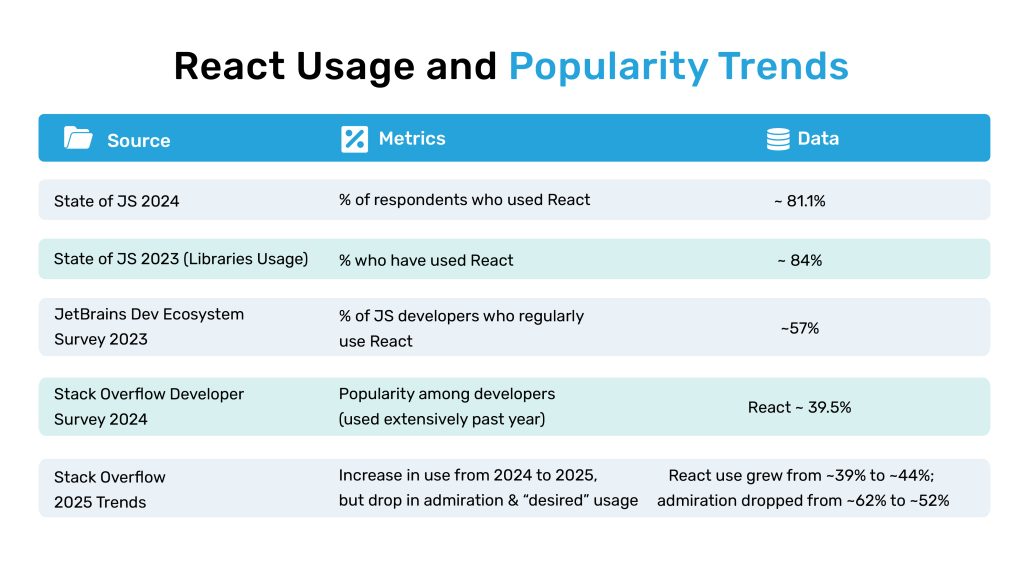
React is expected to hold onto its about 40% market share and continue to be widely used when creating modern technology that makes use of server components and edge-first applications to maintain its status as a major player in the developer industry.
Benefits of Developing a Website with ReactJS in 2026
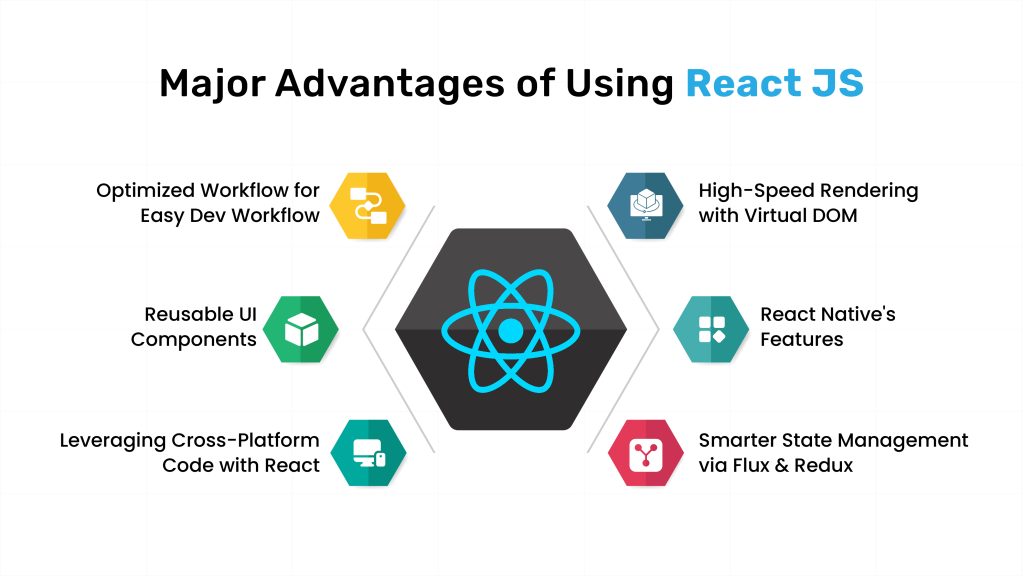
Optimized Workflow for Easy Dev Workflow
React’s rapid performance and compact API ensure that developers’ programming workflows are optimized. The component model’s simplicity makes it perfect for developers to “get started” in less than an hour. But it is deep enough to understand and explore further down the line.
Unlike Angular and Vue, React does not provide any additional functionality to HTML to safeguard your code. React lets developers write JSX within JavaScript, making their code more comprehensible and extensible when interacting with components.
ReactJS also establishes the framework for scaling projects over time. Thus, this is yet another important benefit of React that addresses what React offers in terms of modern web development.
Flexibility & Compatibility
React excels in terms of compatibility and flexibility. Once you’ve mastered the React framework, you may utilize your abilities to swiftly develop web applications. It includes React JS mobile applications, static websites, and interactive experiences such as VR.
React will provide server rendering, desktop apps, and fast advanced integrations in addition to its extensive ecosystem. It is fueled by an established community. One of the main reasons React used in modern development is its ability to adapt to the evolving requirements of developers.
The Reuse of UI Components Streamlines Development Speed
One of the primary benefits of using React as the framework for building user interfaces (UIs) is that it utilizes a component-based approach. In this way each component represents an independent UI element. React components are easy to create, develop, and reuse. For React developers building large applications, having separate rendering cycles allows for consistent presentation of components throughout an application.
React components can be used in any other application built with the same library, meaning that there is no need to recreate the component or alter its functionality. Both of these capabilities allow developers to build and modify large applications quickly, while also guaranteeing the same overall experience across all applications they build with the same technology.
High-Speed Rendering with Virtual DOM
Performance is among the primary benefits of ReactJS because of its virtual DOM, among other things. What does React do with a virtual DOM? Rather than wasting time and resources, React renders the output more quickly by altering it in memory and only applying the necessary modifications to the actual DOM.
You can get real-time updates using this quick way, which gradually uses less energy and CPU power, especially on mobile devices. React recognizes the necessity of a performance-driven application on all platforms.
Smarter State Management via Flux & Redux
Large applications make data handling extremely difficult, but React helps you overcome this challenge via Flux and Redux. Flux operates on unidirectional data flow to alleviate concerns regarding duplicate data while preserving consistency throughout views.
Following this similar philosophy, Redux generates a single store to handle all the different kinds of data in your project instead of creating separate data stores for each type of data. Two desirable outcomes of using a single app store are simplifying debugging and maintaining the data status of your app. It also involves keeping all of your components in sync with your app data.
Powerful Tools for Modern Developers
React development provides a complete toolkit in the form of an extremely production-focused framework. The React developer tools application is undoubtedly one of the most crucial technologies that each React project should use. They are available as a Chrome plugin, allowing developers to explore their React components, attributes, and modes while analyzing a DOM node in real time.
Redux DevTools is another helpful Chrome plugin that lets developers monitor state changes, identify what activities caused them, and enable time travel debugging and step-by-step state change replay. Using React Development Tools for current content management systems, static content management systems, or rich visual editors is a great way to assess the overall productivity of React’s ecosystem.
React Native’s Features
You may be wondering, “All of that is great, but why use React for web development in more progressive projects?” Would it meet my requirements if I were about to launch a native or hybrid app development project?” This is where React Native emerges as a true game changer, permitting native and hybrid mobile app development for iOS and Android. Naturally, you lose some code reusability opportunities, but only for the sake of excellent native performance and system management.
Developing a one-size-fits-all app can be less expensive. You can also go hybrid for more custom results, leveraging a similar codebase to produce somewhat different solutions for different operating systems.
Key Scenarios Where React Outperforms Other Frameworks
While React is a flexible library, when utilized to its core capabilities, it is an absolute beast in some scenarios. It’s not just that you can make cool stuff with React. It’s also about What React is used for in the real world, which escalates development speed, intelligence, and scalability.
Let’s look at some of the key scenarios developers and businesses feel comfortable adopting React for.
Single-Page Apps (SPAs)
Have you ever noticed how apps like Trello and Gmail allow you to click and change move cards without reloading the full page? That can be done with a one-page application. It basically loads a single HTML page and only makes changes to specific parts of it while you interact with it. This creates the illusion that you are using a desktop program.
You can look into this in the React documentation.
Why React works well for this: React employs a virtual DOM to update things in a way that is ideal for SPAs. It enables you to update the user interface fast.
These programs are ideal for creating up-to-date websites. Consider Facebook, project management tools like Asana, and a variety of SaaS platforms.
Complex and Interactive User Interfaces
When your app has lots of user interaction, real-time updates, and complex screens, you will want to use React. Consider fast-updating dashboards or online tools with lots of interactive features.
React is useful because it allows you to divide complex UIs into smaller, distinct components. This facilitates the development and debugging of complex interfaces.
Good for building: Real time data dashboards, chat applications, interactive data visualizer tools like Figma, and complex online forms..
Cross-Platform Mobile Apps Using React Native)
Consider the idea of a single app that works across Android and iPhone. You can, using the same technology used for webpages. This is what React Native gives you, as they are sister frameworks to React.js and utilize the same React principles of achieving a truly native mobile app experience.
Why React is good for this: You write your code once, and you can deploy it on 2 different platforms. This saves a significant amount of time and expenditure, as opposed to creating 2 separate applications from scratch.
Good for building: Many of the applications you use frequently, for example Instagram, Shopify, Discord, and Pinterest. This makes ReactJS mobile application development one of its greatest benefits.
Reusable UI Components and Design Systems
In large enterprises, it is essential that digital products maintain a consistent brand and user experience. React’s component model is perfect for developing a uniform set of UI components or a design system.
Why React is perfect in this situation: With React, we can create an aggregate set of “standardized components,” such as buttons, dropdowns, and form fields, to leverage as a company. This greatly reduces the amount of effort needed to develop new projects and continue on with that same vibe and feel.
Great for building: An enterprise-level app and product packages always need a consistent feel and look for things to function correctly.
Real Time Data Updates in Applications
If your application has data that is updating every second, you will need a framework that is able to keep up with the changes without crashing the user’s browser.
Why React is perfect for this: It allows the user to conduct a rerender on only the part of the UI that has actually been impacted by the change of the data, which is wonderful for any type of live data streaming application. The remainder of the page stays intact with no changes made. This is great for building trading apps with stock tickers, betting apps with live scores, and news feeds on social.
Progressive Web Applications (PWAs)
PWAs are web apps that can create a similar user experience as a native app. PWAs have many of the same features that a native app would expose to its platform (i.e., Android, iOS, and so on), but PWAs do not require users to download them from the marketplace and then install them on their device, as is typically done with a native app, also support the user experience features of offline use, push notifications, and direct installation onto users’ mobile device home screens.
So, What is React used for? React provides performance enhancements and a “component” architecture that meets your needs. PWAs will give you the ability to deliver efficient, fast, and responsive applications for each of your users across all devices.
Websites That Are SEO-Friendly With Server-Side Rendering (SSR)
Web apps built using Single Page Applications (SPAs) historically posed issues for search engines (like Google) to “see” your site content, which can inhibit SEO capabilities. The development of React and frameworks like Next.js has made server-side rendering easy and practical. The server can build the initial page and send it to the client.
You get the benefits of an SPA! A React.js website can provide the user with a fast time to first paint due to the initial page being loaded from the server and a fast full html page for crawlers to crawl, which all adds up to great SEO performance!
Great for building: E-commerce sites like Walmart, large content-focused blogs, and new sites, where discoverability on Google is paramount.
Developing Large Applications with Large Teams
As the project grows with more developers, there is a lot of value in making an effort to keep a clean and maintainable codebase.
Why is react good to accomplish this? The component-based architecture, predictable data flow, and large community to support it encourage good behaviors of developers. Altogether, this makes it very easy to onboard new team members, and you have a shared codebase.
Good for building: Applications like Netflix, PayPal, Uber, etc. are difficult to operate at a large scale.
React’s versatility makes it a successful business partner, as evidenced by everything from speedy single-page apps to enormous e-commerce websites and mobile apps. React’s ability to be used for such a wide range of digital experiences is due to a common design principle of component-based principles and a major goal of efficiency.
Final Verdict
Now it’s obvious that React can make a good idea a great digital experience, and that’s part of the reason it is the most popular frontend framework. If you ever wondered, “What is React used for?” The answer is simple: building fast, scalable, and interactive web and mobile apps. But turning that potential into a finished, optimized application requires a lot of experience! So, how do you bring your ideas to life without the headache of managing a difficult development project?
That’s where OCloud Solutions can benefit. Rather than spending months learning React or searching for expertise, you can instantly connect with our expert pre-vetted React developers. We are well-known for our WordPress expertise, but our developers are also professionals in modern frameworks such as React. Whether you are creating a completely new application or swiftly enhancing your current website, we can identify the best talent for your task.