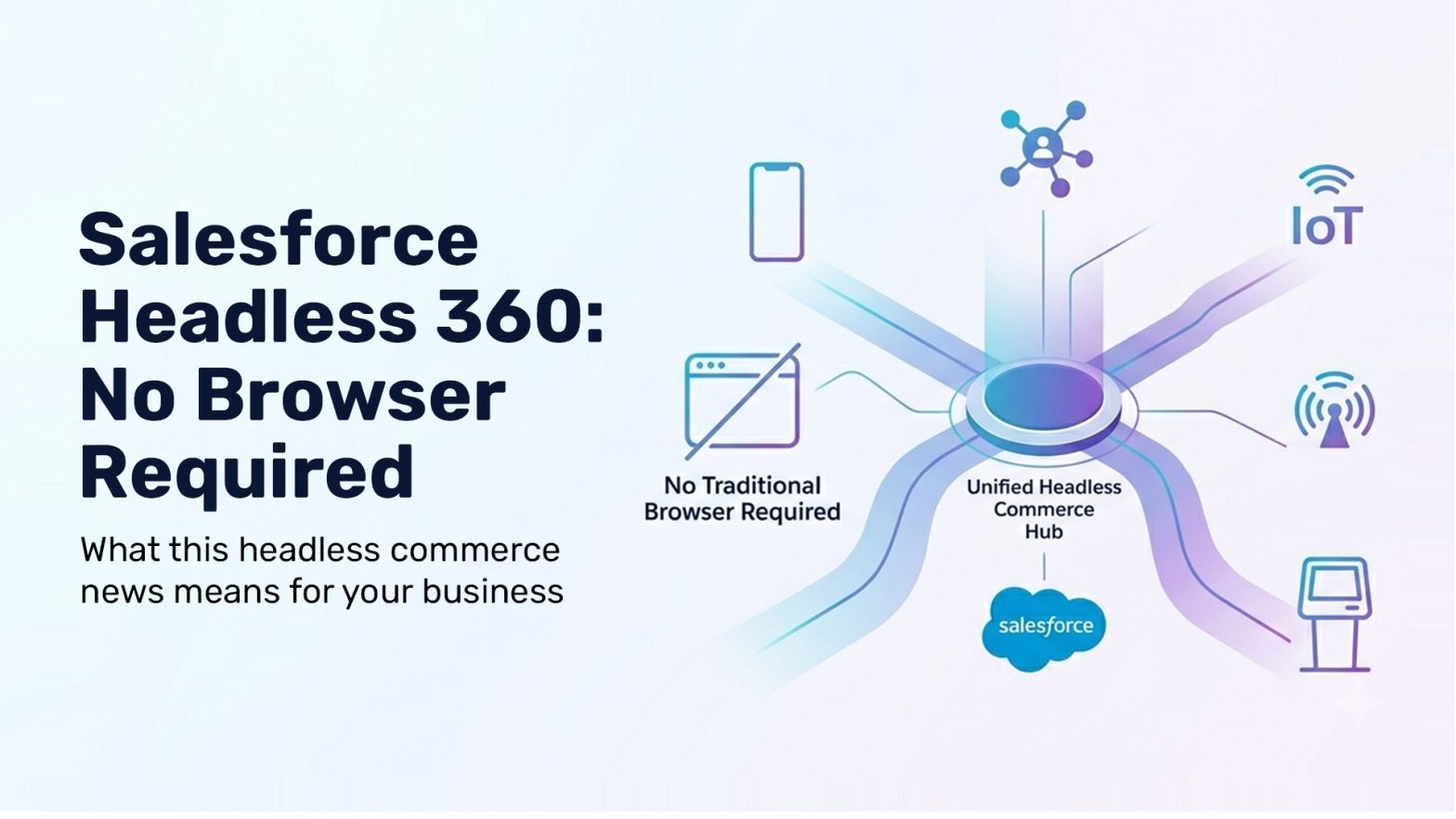
The Headless Commerce News You Should Read
Salesforce just asked a question that looks small but changes a lot of things.
At a recent event, Co-Founder Parker Harris asked, “Why should you ever log into Salesforce again?” He didn’t mean it as a joke, NO. He meant it as a direction for where the platform is going.
The answer is on April 15, 2026, with the launch of Salesforce Headless 360. And it’s the kind of headless commerce news that affects how teams build, sell, and serve customers, not just how developers write code.
Let’s break it down in simple terms.
What is Salesforce Headless 360?
Salesforce Headless 360 is a new setup where almost everything on the platform works as an API, an MCP tool, or a CLI command.
In plain words: the features that used to live behind buttons and screens are now open. Software and AI agents can reach them directly, without a human clicking through pages.
So a person can still log in and work the normal way. But an AI agent can also pull the same data, run the same workflow, and finish the same task on its own.
The screen changes. The platform underneath stays the same.
What does “headless” actually mean?
A normal app glues two things together: the back end (data and logic) and the front end (the screen you look at).
“Headless” means you cut those two apart. The back end keeps the data and rules. The front end can be anything, a website, a mobile app, a chat window, or an AI agent.
That’s the whole idea behind headless commerce. Your store, your CRM, and your tools run in the background, and you serve them on any screen your customers use.
This is why developers like the approach. They get full freedom over the design while the heavy lifting stays in one trusted place.
The 3 big things Salesforce announced
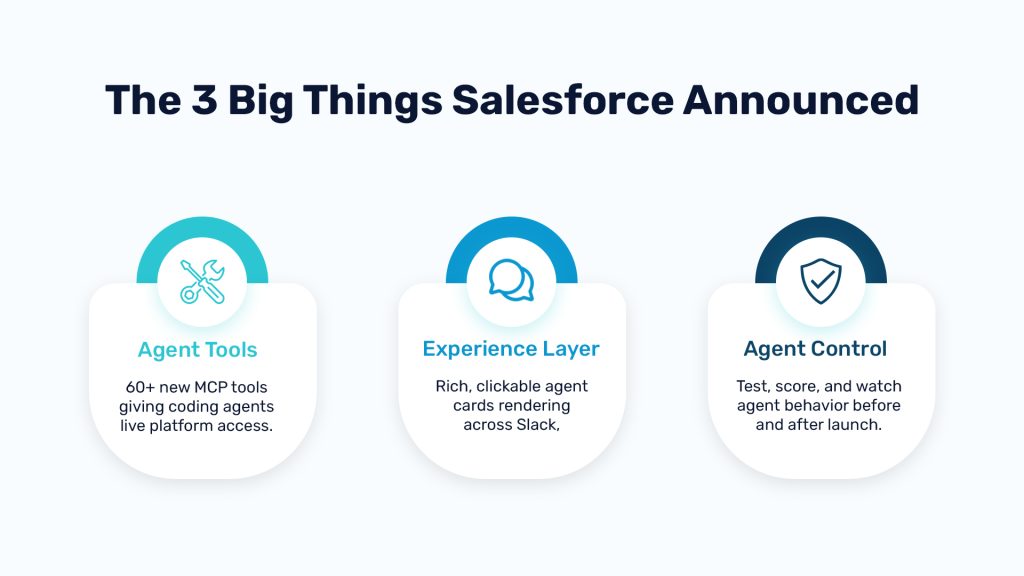
Headless 360 brings three updates worth knowing:
- More agent tools. Salesforce added 60+ new MCP tools and 30+ ready-made coding skills. These give coding assistants like Claude Code, Cursor, and Codex live access to your data and workflows.
- A new experience layer. Agents can now show rich, clickable items, like approval cards or status tiles, right inside Slack, WhatsApp, Teams, mobile, and other chat tools. Build it once, and it shows up everywhere.
- More control over agents. New tools let you test, score, and watch how an agent behaves before and after launch. If an agent drifts off track, you can find the cause in hours instead of weeks.
Together, these turn Salesforce into a place where people and AI agents work side by side.
Salesforce Agentforce 360 news: where agents fit in
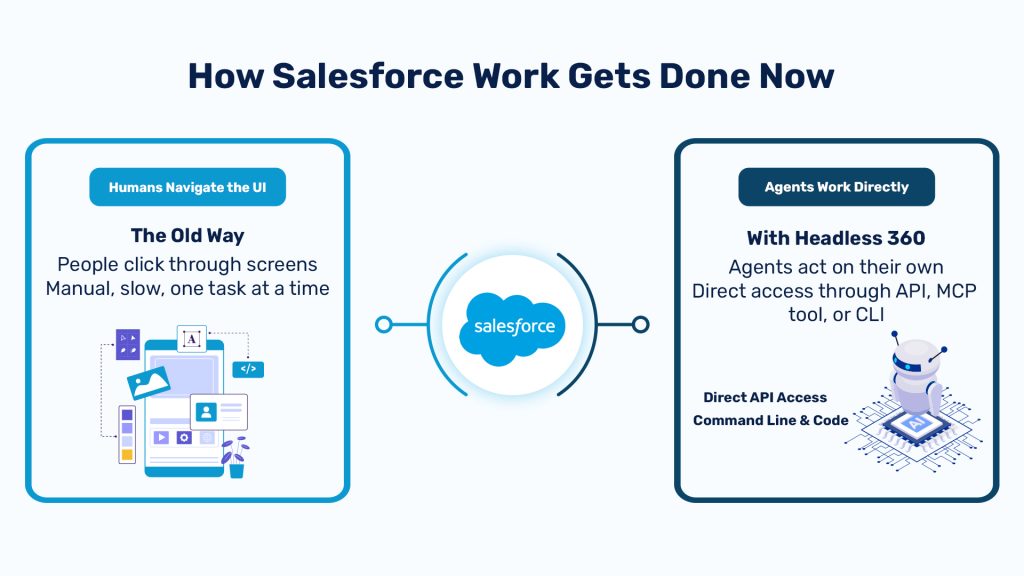
Agentforce is the Salesforce system that builds and runs AI agents. With Headless 360, those agents get full reach across your data, your workflows, and your business rules.
A new release called Agentforce Vibes 2.0 adds something useful: the agent understands your whole org from the start. It supports more than one AI model, including Claude Sonnet and GPT-5, so you’re not locked into a single choice.
There’s a real reason this matters. Custom AI agents on Slack have grown 300% since January. Teams want help where they already talk, not in a separate tab.
If you want to set up agents for support, lead handling, or daily tasks, our Salesforce development team builds Agentforce solutions that connect cleanly with Customer 360.
Why this matters for headless Salesforce Commerce Cloud
If you run a store on Salesforce, this shift is good news.
A headless Salesforce Commerce Cloud setup lets you keep your products, pricing, and orders in Salesforce while you design the storefront however you like. A fast React site, a mobile app, a smart assistant, your call.
Headless 360 makes that even easier because the data and logic are now exposed as clean APIs. Your front end talks to the back end without messy workarounds.
The result is a store that loads fast, looks the way you want, and stays simple to update.
Headless integration done right
A headless setup only works when the pieces connect well. That part is called headless integration, and it’s where many projects slow down.
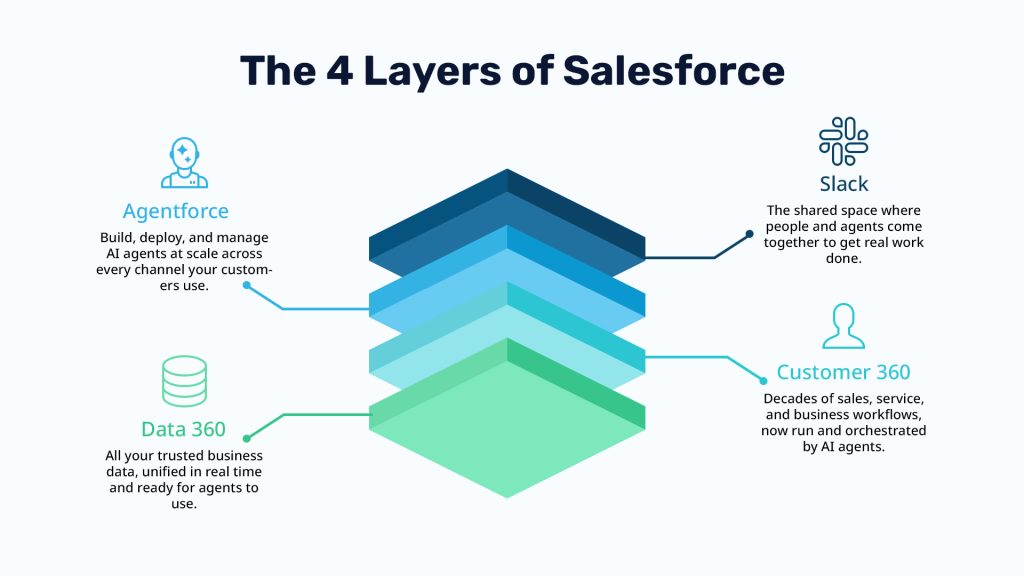
Good integration means your front end, your data, and your tools talk to each other without errors or delays. Salesforce’s four built-in layers help here:
- Data 360 holds your trusted data.
- Customer 360 holds your workflows and business logic.
- Agentforce builds and runs your agents.
- Slack is where people and agents meet to get work done.
Most platforms give you one or two of these. Salesforce now ties all four together, so agents inherit your rules and permissions instead of rebuilding them from scratch.
If you need help wiring this up, our Salesforce integration services and custom web development team handle the front-to-back connection.
Looking for headless commerce development services?
Building headless takes a bit more planning than a standard site. You’re managing a back end, a front end, and the link between them.
That’s where the right partner helps. Solid headless commerce development services cover the full job: clean API setup, a custom storefront, agent support, and ongoing care after launch.
We’ve done this kind of work for real clients. For example, we built a custom Salesforce ERP for GoldFinch and an AppExchange lead-routing app called Decision on Demand. Both run on the same platform power Headless 360 is built around.
Want to see how a headless build would fit your business? Talk to our team and we’ll map it out with you.
How to get free headless tools to test first
You don’t have to spend big to try headless. Here’s how to get started for free:
- Use a free trial. Salesforce and many headless platforms offer trial or sandbox accounts so you can test before you buy.
- Try open-source options. Some headless CMS and commerce tools are free to use and great for small projects.
- Start with a sample build. Many coding agents now include free starter skills you can use to spin up a basic headless front end.
A free trial is enough to feel out the workflow. When you’re ready to go live with real traffic, that’s the point to bring in a development partner.
Quick FAQ
What is headless commerce in one line? It’s when your store’s data and logic run separately from the screen customers see, so you can use any front end you want.
What does “headless ID code” mean? In a headless setup, the headless ID code is the small snippet or unique identifier a developer uses to connect a front end to back-end services through an API. It’s how the screen knows which data to pull.
Is Salesforce Headless 360 only for big companies? No. Small and mid-size teams benefit too, especially anyone who wants AI agents handling routine work.
Do I need to stop using the Salesforce screen? Not at all. People can still log in and work as usual. Agents just get a second path to the same tools.
Can I run agents I can trust? Yes. The new testing and scoring tools let you check an agent’s behavior before launch and watch it after, so you stay in control.
The bottom line
Headless 360 is more than a feature update. It’s Salesforce saying the screen is no longer the only way in.
People and AI agents now share the same data, the same rules, and the same workflows. That opens the door to faster builds, smarter stores, and support that runs around the clock.
If you’re thinking about a headless or Agentforce project, reach out to OCloud Solutions. We’ll help you build it the right way, on a platform you already trust.