If you work with Salesforce, you have probably heard the buzz around Salesforce Agentforce. It is one of the biggest shifts the platform has seen in years, and it is changing how teams think about AI at work.
But what is Agentforce, really? In plain terms, it is Salesforce’s platform for building and running AI agents — software “workers” that can reason, make decisions, and complete tasks on their own, right inside your CRM.
This guide breaks it all down for 2026: how it works, the most useful agentforce use cases, what it means for agentforce for sales teams, and how to get started. No hype, just a clear picture you can actually use.
What Is Agentforce? A Simple Definition
Agentforce is a layer within Salesforce that lets you create autonomous AI agents. Think of an agent as a digital teammate. You give it a job, a set of guardrails, and access to your data, and it handles the work without someone clicking through every step.
Earlier Salesforce AI, like Einstein, mostly suggested things — a predicted score, a recommended reply, a draft email. Agentforce goes further. Its agents can take action: answer a customer, update a record, book a meeting, or escalate a case to a human when needed.
That shift, from “AI that suggests” to “AI that does,” is why people call this agentic AI. The agent does not just assist a person; in the right conditions, it completes the task itself.
How Does Salesforce Agentforce Work?
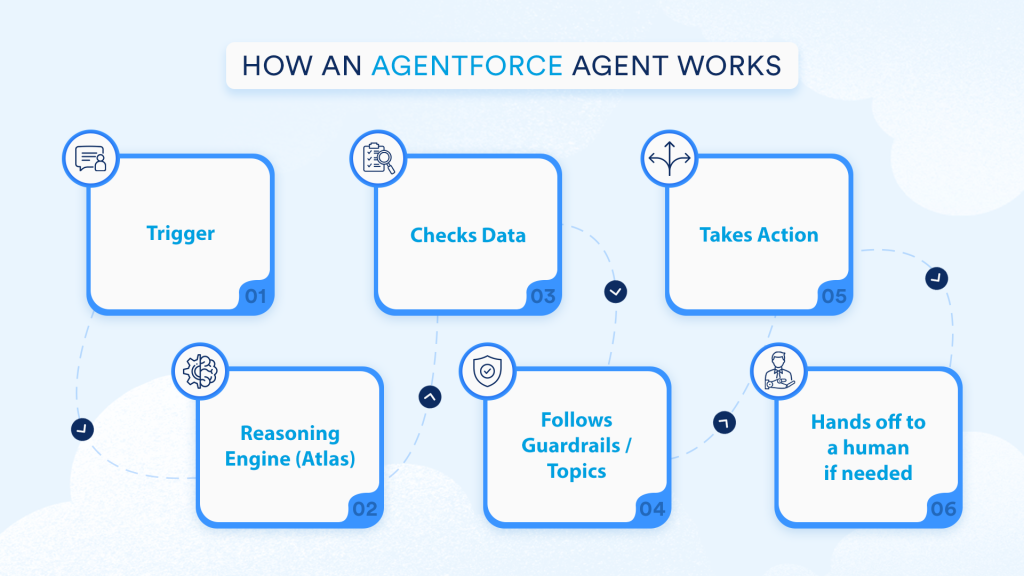
Agentforce runs on a few connected pieces. You do not need to be an engineer to understand them — here is the plain-English version.
The reasoning engine
At its core sits a reasoning engine (Salesforce calls it the Atlas Reasoning Engine). It reads a request, works out what the user actually wants, and decides the steps to take. This is the “brain” that uses large language models behind the scenes.
Your data and grounding
An agent is only as good as the data it can see. Agentforce connects to your CRM records and Salesforce Data Cloud so answers are “grounded” in real, current information — not guesses. This keeps responses accurate and on-brand.
Topics, actions, and guardrails
You define what an agent is allowed to handle (topics), what it can do (actions like updating a case or sending a quote), and where it must stop or hand off to a person (guardrails). This is what keeps an agent safe and predictable.
If your team already uses generative AI tools, this will feel familiar. For a wider view of the technology underneath, our guide to generative AI is a helpful companion read, and our generative AI development services cover building this kind of solution end to end.
Why Agentforce Matters in 2026
Businesses are under pressure to do more with the same headcount. Customers expect instant, around-the-clock answers. Support queues grow faster than teams can hire. This is the gap Agentforce is built to close.
Salesforce frames this as “digital labor” — AI agents working alongside your people, taking the repetitive load so humans focus on judgment, relationships, and complex problems. Used well, it is less about replacing staff and more about extending what a small team can deliver.
- 24/7 availability without adding night-shift staff
- Faster response times on routine questions and tasks
- Consistent, on-brand answers grounded in your real data
- Human agents freed up for high-value, complex work
Top Agentforce Use Cases
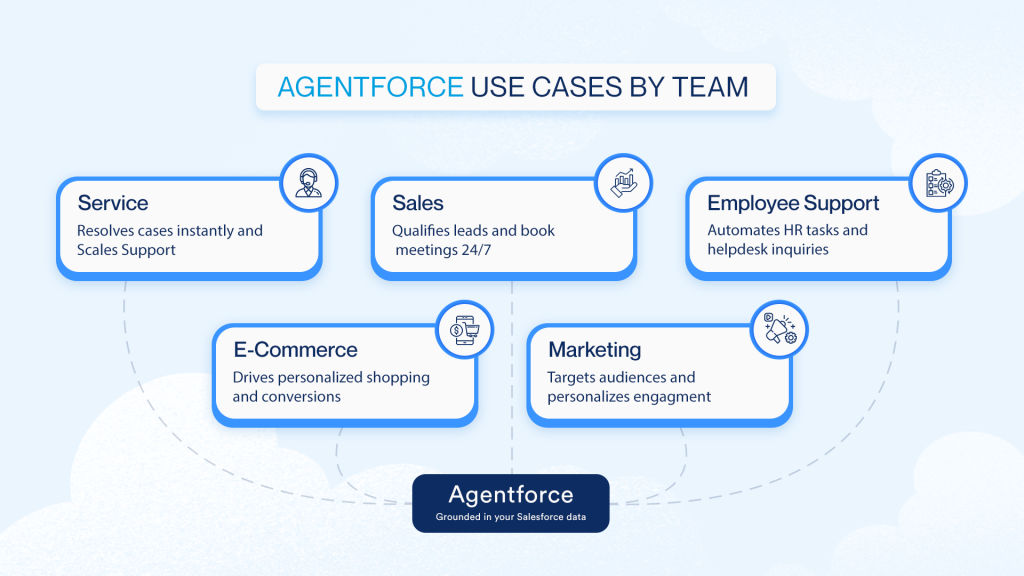
The best way to understand Agentforce is to look at real agentforce use cases. Here are the ones delivering value for businesses right now.
1. Customer service agents
A service agent resolves common questions — order status, returns, account changes — in natural language, any time of day. It pulls from your knowledge base and case history, and escalates to a human when an issue is sensitive or complex.
2. Sales development and lead follow-up
This is where agentforce for sales shines. An agent can qualify inbound leads, answer product questions, nurture prospects, and book meetings on a rep’s calendar — so no lead goes cold while your team sleeps.
3. Internal employee support
Agents help your own staff too — answering HR or IT questions, guiding people through processes, and surfacing the right document or policy on demand, all inside the tools they already use.
4. E-commerce and shopping assistants
On a storefront, an agent recommends products, answers sizing or stock questions, and helps complete checkout — turning browsing into buying with a guided, conversational experience.
5. Marketing and campaign support
Agents can help build audience segments, draft campaign content, and answer questions about performance, giving lean marketing teams more reach without more hours.
Agentforce for Sales: A Closer Look
Sales teams feel two pains constantly: too many leads to follow up properly, and too little time for the deals that matter. Agentforce for sales tackles both.
- Instant lead response — the agent engages a new lead the moment it arrives, when interest is highest.
- Smart qualification — it asks the right questions, scores the lead, and routes hot ones to a rep.
- Meeting booking — it checks calendars and schedules calls without back-and-forth emails.
- Follow-up that never forgets — it nurtures slow leads so they are not lost to silence.
The result is a sales motion where reps spend their energy on conversations that close, while the agent handles the steady, repetitive groundwork. If you are already running lead-routing automation, this pairs naturally with work like our Decision on Demand lead-assignment project.
Salesforce Agentforce Partners: Why Implementation Matters
Agentforce is powerful, but it is not a switch you simply flip on. Designing agents, connecting clean data, defining safe guardrails, and testing thoroughly all take real expertise. This is exactly where salesforce agentforce partners come in.
A good implementation partner helps you avoid the common traps: agents grounded in messy data, missing guardrails that let an agent overstep, or use cases chosen for novelty rather than value. They start with your business goals, then build agents that actually move the needle.
As an experienced Salesforce team, OCloud Solutions helps businesses plan, build, and launch Agentforce safely. You can explore our Salesforce development services to see how we approach it, and browse our case studies — including Salesforce builds like Madison Energy Infrastructure — to see the kind of results we deliver.
How to Get Started With Agentforce
You do not have to transform everything at once. The smartest rollouts start small and grow with evidence. Here is a practical path.
- Pick one high-value, repetitive use case — for example, answering top customer questions or qualifying inbound leads.
- Clean and connect your data so the agent is grounded in accurate, current information.
- Define clear topics, actions, and guardrails so the agent knows what to do and when to hand off.
- Test with real scenarios, including edge cases, before going live.
- Launch, measure results, and expand to new use cases based on what works.
This measured approach turns Agentforce from a buzzword into a steady source of real, compounding value.
Agentforce Best Practices and Tips
- Start with data quality — an agent grounded in bad data gives bad answers. Fix the foundation first.
- Keep humans in the loop — design clear escalation so sensitive cases reach a person quickly.
- Define narrow topics first — a focused agent that does one job well beats a vague one that does many jobs poorly.
- Measure real outcomes — track resolution time, conversion, and hours saved, not just “messages handled.”
- Review and refine regularly — treat your agents as living systems that improve over time.
Final Thoughts
Agentforce represents a genuine shift in how work gets done on Salesforce — from AI that advises to AI that acts. For businesses willing to start small, ground their agents in good data, and choose use cases with real value, the payoff is faster service, stronger sales follow-up, and teams freed for the work that matters most.
Ready to explore what Agentforce could do for your business? Talk to the OCloud Solutions team and let’s map out a practical first project together.
What is Salesforce Agentforce in simple terms?
Salesforce Agentforce is a platform for building AI agents — autonomous digital workers that can reason, make decisions, and complete tasks inside your CRM, such as answering customers, updating records, or booking meetings, with human oversight.
How is Agentforce different from Einstein?
Einstein mainly predicts and suggests — a score, a recommendation, a draft. Agentforce goes a step further: its agents take action and complete tasks autonomously within the guardrails you set, rather than only assisting a person.
What are the best Agentforce use cases?
The strongest agentforce use cases are customer service, sales lead qualification and follow-up, internal employee support, e-commerce shopping assistants, and marketing support. The best first project is one repetitive, high-volume task with clear value.
How does Agentforce help sales teams?
Agentforce for sales responds to leads instantly, qualifies and scores them, books meetings, and nurtures slower prospects automatically — so reps focus on closing while the agent handles repetitive groundwork around the clock.
Do I need a partner to implement Agentforce?
While you can start on your own, most businesses benefit from salesforce agentforce partners. A partner ensures clean data grounding, safe guardrails, the right use cases, and thorough testing — avoiding costly mistakes and speeding up results.
Is Agentforce safe to use with customer data?
Yes, when set up correctly. Agentforce grounds responses in your governed Salesforce data and lets you define strict topics, actions, and guardrails, plus human escalation — keeping agents accurate, on-brand, and within safe limits.