I’ve been building software for years and the java vs python conversation comes up constantly. Not because people don’t know the answer. Because the answer genuinely depends on what you’re building and most articles online just won’t commit to a real take. I will.
Python wins for most of what we build at OCloud Solutions. That’s my opinion and I’m sticking to it. But Java isn’t dead and pretending otherwise would be dishonest.
Why Python Keeps Pulling Ahead
The python advantages over java are most obvious the moment you sit down to write something. Python lets you express an idea in four lines. Java makes you write eight. And wrap it in a class. And declare every type. I’m not saying Java is wrong for doing that but if you’re trying to ship an MVP in weeks not months that ceremony adds up fast.
We’ve watched this play out with our own clients. Teams that came to us wanting to validate an idea and build fast. Python every time. Not because it’s trendy but because it’s practical.
The Speed Conversation Is More Complicated Than People Think
Java is faster at runtime. That’s just true. It compiles to bytecode and runs on the JVM which gives it a real edge in long-running compute-heavy workloads. Python is interpreted which means it runs line by line and yes that costs you something at scale.
But here’s the thing most people skip: Python starts faster and in the context of data science workflows or API calls or automation scripts the runtime difference is often invisible to the end user. Over 60% of new machine learning projects in 2024 were started in Python not because developers didn’t know Java but because the ecosystem around things like TensorFlow and PyTorch is just built for Python.
Typing Systems and Why They Actually Matter
Dynamic typing in python programming vs java’s static typing is probably the most meaningful technical difference day to day. Python figures out types at runtime. Java makes you declare them upfront and the compiler checks your work before anything runs.
I used to think static typing was just extra ceremony. I was wrong. On a team of 12 developers touching the same codebase over two years Java’s type system catches mistakes that Python doesn’t even blink at. That matters. The tradeoff is real and you have to be honest about it.
Development Speed and What It Costs You
Building an MVP in Python takes weeks. The same thing in Java takes months. I’ve seen this enough times that I don’t hedge on it anymore.
Java projects at serious enterprise scale regularly run 12 or more months before first release. That’s not a flaw. That’s the cost of the structure you’re buying. But for a startup trying to figure out if anyone even wants what they’re building that timeline is a problem.
Python requires smaller teams too. Fewer engineers to get to a working product. That’s real money and real time back in your pocket during the phase where you’re still figuring things out.
When Java’s Cost Is Worth It
There’s a moment in a company’s life where the math flips. Once you have real enterprise scale. Real concurrent users. Real regulatory requirements. Java’s upfront investment starts paying back with interest. The libraries alone are impressive: Drools for business rules Lucene for search Hadoop for big data. Decades of enterprise-grade tooling baked in.
Java and Python Code Examples
To illustrate the syntactical differences between Java and Python, let’s look at both of these languages. handle a simple task: adding two numbers and displaying the result.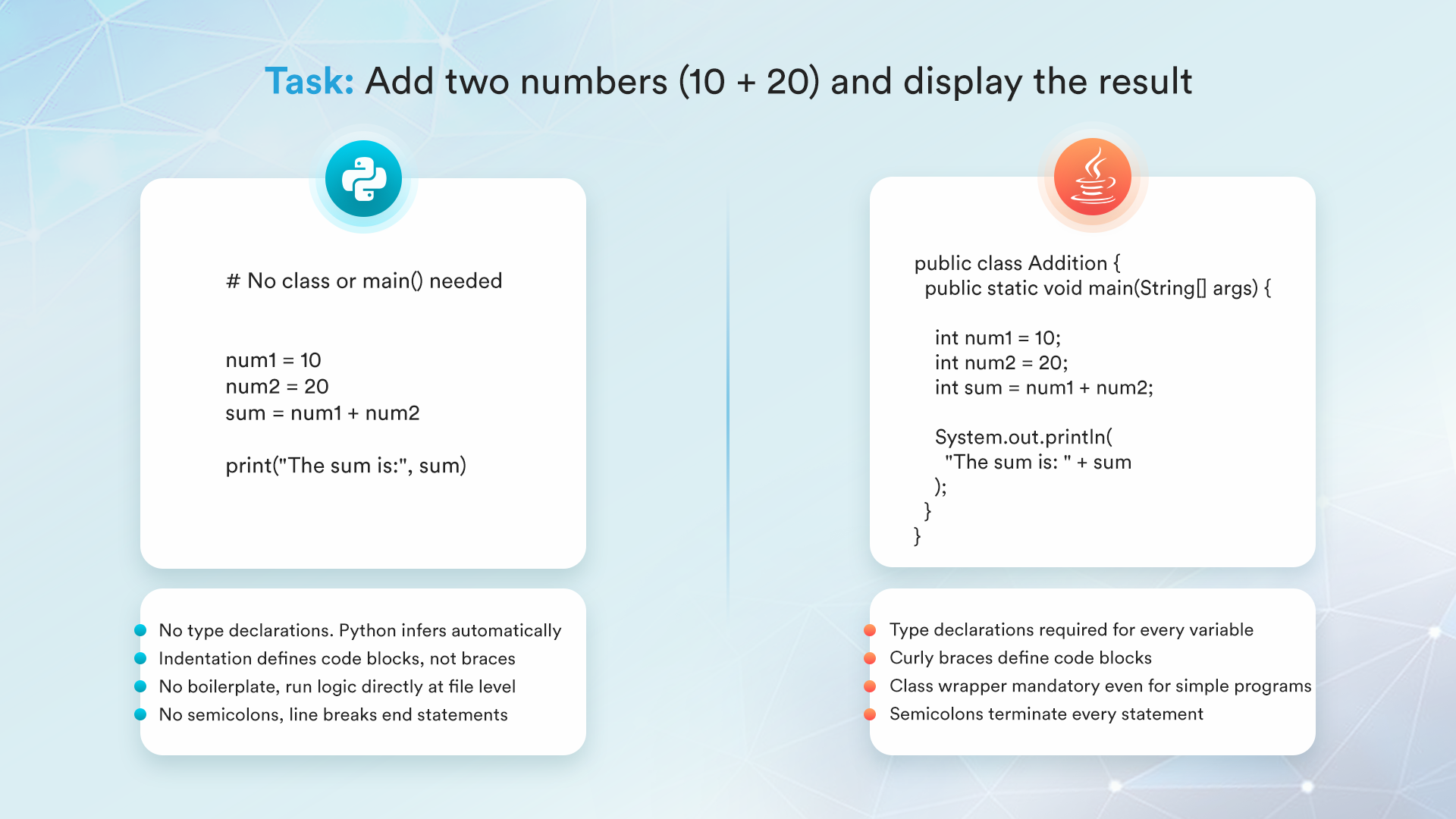
A Quick Tangent That’s Actually Relevant
A few years back I was using a really old Java application for something completely unrelated to coding. And it just worked. No updates needed. No deprecation warning. The thing was bulletproof. It ran fine on hardware it was never designed for because the JVM abstracted all of it away. That experience stuck with me. Write once run anywhere is not just a marketing slogan.
That said I still reach for Python first when we’re scoping new client work at oCloud Solutions.
Where Each Language Fits in 2026
Python is the right call for machine learning and AI work (TensorFlow and PyTorch and scikit-learn all live here). For data science and analytics. For rapid prototyping. For API development using frameworks like Flask FastAPI and Django. For automation and scripting. For small to mid-size web applications. Our python-powered development work at OCloud Solutions covers most of these.
Java owns Android development. High-performance backend infrastructure. Financial services and fintech platforms where uptime and correctness aren’t negotiable. Large-scale systems that need strict type safety across big teams. Long-running servers with serious concurrency demands.
And both languages are inside the stacks of companies like Google, Netflix, Uber, Instagram, and Airbnb. That’s not an accident. These aren’t competing tools in the way people frame them. They solve different problems differently.
Python Vs Java-Key Differences Developers Should Know in 2026
Differences between Python and Java begin at the most fundamental level.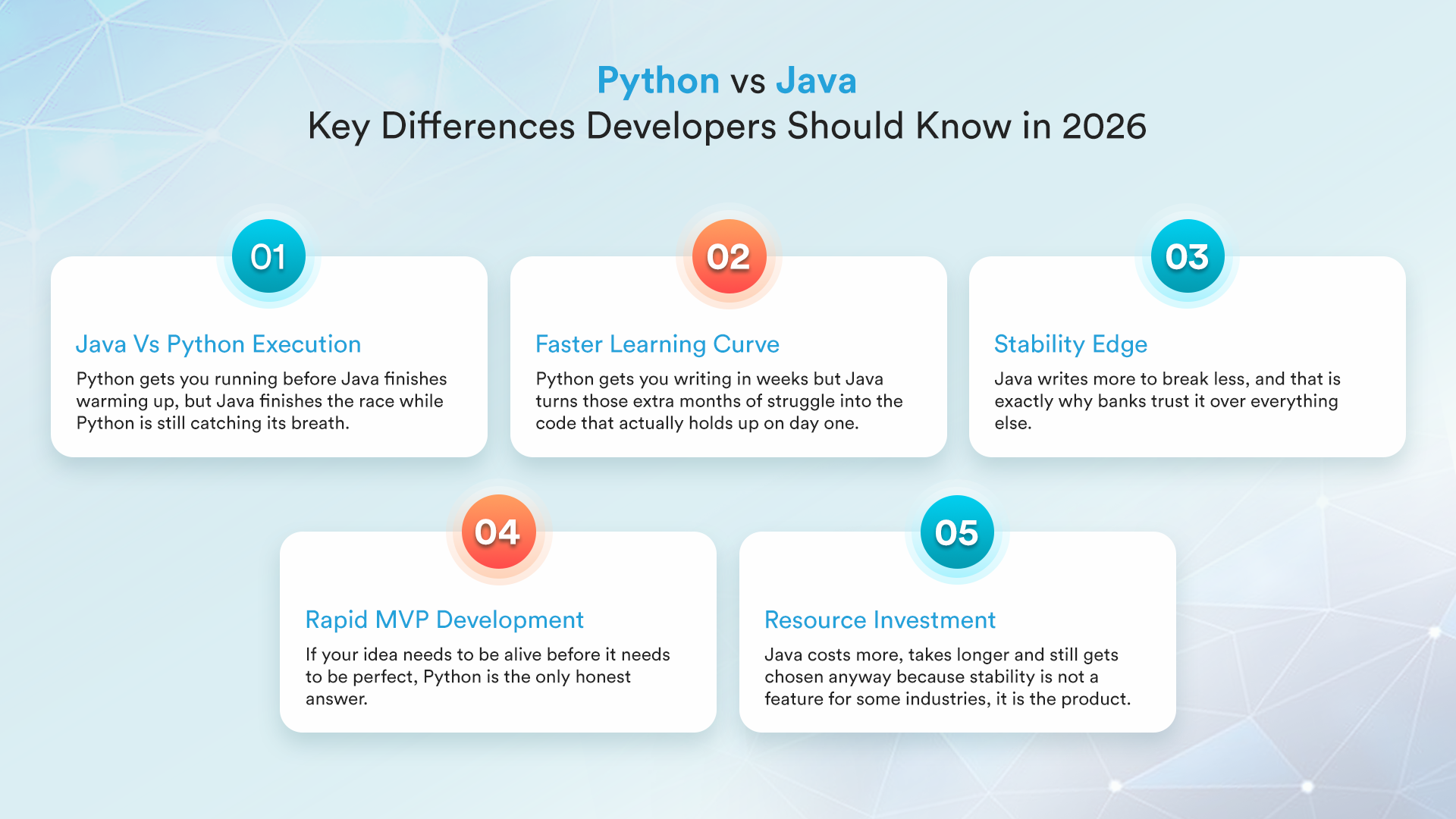
The Ecosystem Question
Python’s ecosystem for AI and data is UNMATCHED right now. Full stop. Java has decades of enterprise tools but the python versus java gap in machine learning libraries is so wide it’s not even a contest in 2026. If you’re building anything that touches ML or data science starting in Java would be a strange choice.
Java’s enterprise ecosystem still wins in certain specific categories. But those categories are getting narrower every year as Python frameworks mature.
What It Actually Costs to Build in Each
Python developers cost less on average than Java developers in enterprise contexts though the gap has narrowed. Python requires less boilerplate which means less code to write review and maintain. Smaller teams. Faster cycles.
Java development costs more and takes longer but it produces structured maintainable code that scales across large organizations with long product lifespans. For a company that’s planning a 10-year product roadmap with 50 developers that higher upfront cost might be completely reasonable.
We help clients at OCloud Solutions figure out which stack fits their budget timeline and team size. There’s no universal answer but there’s almost always a better answer for a specific situation.
FAQs: Python vs Java
Is Python faster to learn than java vs python in terms of onboarding new developers?
Yes and it’s not close. Most learners are writing functional Python scripts within a few weeks. Java’s structure and verbosity means the initial ramp is steeper. But that investment pays back over time on large codebases.
Is Python replacing Java in enterprise work?
Not replacing. Expanding into territory Java used to dominate alone. Python is now inside serious fintech platforms healthcare tech and enterprise data systems. For new AI-driven or data-heavy enterprise systems python programming vs java often tips toward Python as the first choice.
Which pays more in 2026?
Java developers commanded higher salaries historically in enterprise environments. Python has caught up and in machine learning or data science specializations it often exceeds Java now. Both are strong choices for employment.
Can Python handle real enterprise scale?
Instagram. Dropbox. Large financial institutions. All running Python-powered systems at serious scale. The language isn’t the limiting factor. Architectural discipline is. Our team at OCloud Solutions has built Python systems that handle real production load without drama.
Which is better for web development?
Python frameworks like Django and FastAPI move faster in development. Java’s Spring Boot is battle-hardened for high-traffic complex enterprise web apps. The right choice depends on your team and your scale and your timeline. Check out our web development services if you want help thinking it through.
Python vs Java: Summary Comparison Table
| Factor | Python | Java |
| Typing | Dynamic | Static |
| Execution | Interpreted | Compiled (JVM) |
| Syntax | Concise, readable | Verbose, structured |
| Learning Curve | Gentle | Steeper |
| Runtime Speed | Moderate | Fast |
| Dev Speed | Fast (weeks to MVP) | Slower (months) |
| Best For | AI/ML, data, startups | Enterprise, Android, finance |
| Team Size | Smaller teams | Larger teams typical |
| Cost | Lower upfront | Higher upfront |
Final Take
The python benefits over java are clearest in speed of development AI/ML dominance and simplicity of the language itself. Java wins on runtime performance enterprise stability and large-scale system architecture.
Pick the language that fits the project. Don’t pick the language you’re comfortable with and then try to make the project fit that.
If you’re not sure which direction makes sense for what you’re building the team at OCloud Solutions is here to help you think it through and build with confidence.