Every week, a new AI tool gets announced. Every month, a new model breaks a benchmark. And yet most founders, product leaders, and engineering directors are still carrying the same question around with them: what is generative AI, and is it actually worth betting on?
By 2026, that question has a real, measurable answer. JPMorgan Chase runs generative AI systems that scan over $10 trillion in daily transactions. Property management teams now handle 30 to 40% more units per employee thanks to AI handling lease renewals, tenant inquiries, and investor communications autonomously. In education, 86% of organizations now use generative AI, the highest adoption rate of any industry.
This is no longer a research experiment sitting in a lab. It is the operating infrastructure of ambitious businesses right now.
This guide covers exactly what generative AI is, how it works under the hood, where it is delivering returns right now, and how to start building with it inside a real business. If you already know what it is and want to go straight to implementation, our Generative AI services page covers how we approach that work for clients.
What Is Generative AI?
Generative AI is a type of AI that creates new content in response to a prompt. That content can be text, images, audio, video, code, or structured data. The word “generative” is the key part. It generates something new, rather than simply classifying or scoring something that already exists.
The most widely used form today is the large language model, commonly called an LLM. These models are trained on enormous amounts of text and learn the statistical patterns within human language. They can write, summarize, translate, reason, and generate code at a level that continues to surprise the people who built them.
Claude, built by Anthropic, GPT-5 by OpenAI, and Gemini by Google are the most recognized names in the space today. The same underlying technology also powers image tools like Midjourney, voice tools like ElevenLabs, and video tools like Runway and Sora.
Quick definition: Generative AI is software that has absorbed billions of human-written documents, images, and code samples, and developed the ability to produce new, original output on demand. It does not retrieve stored answers. It generates them fresh each time.
Predictive AI vs Generative AI: What Is the Actual Difference?
Most people mix up these two things, and it is easy to see why. Both involve machine learning. Both use large datasets. But they answer fundamentally different questions.
Predictive AI: the forecasting engine
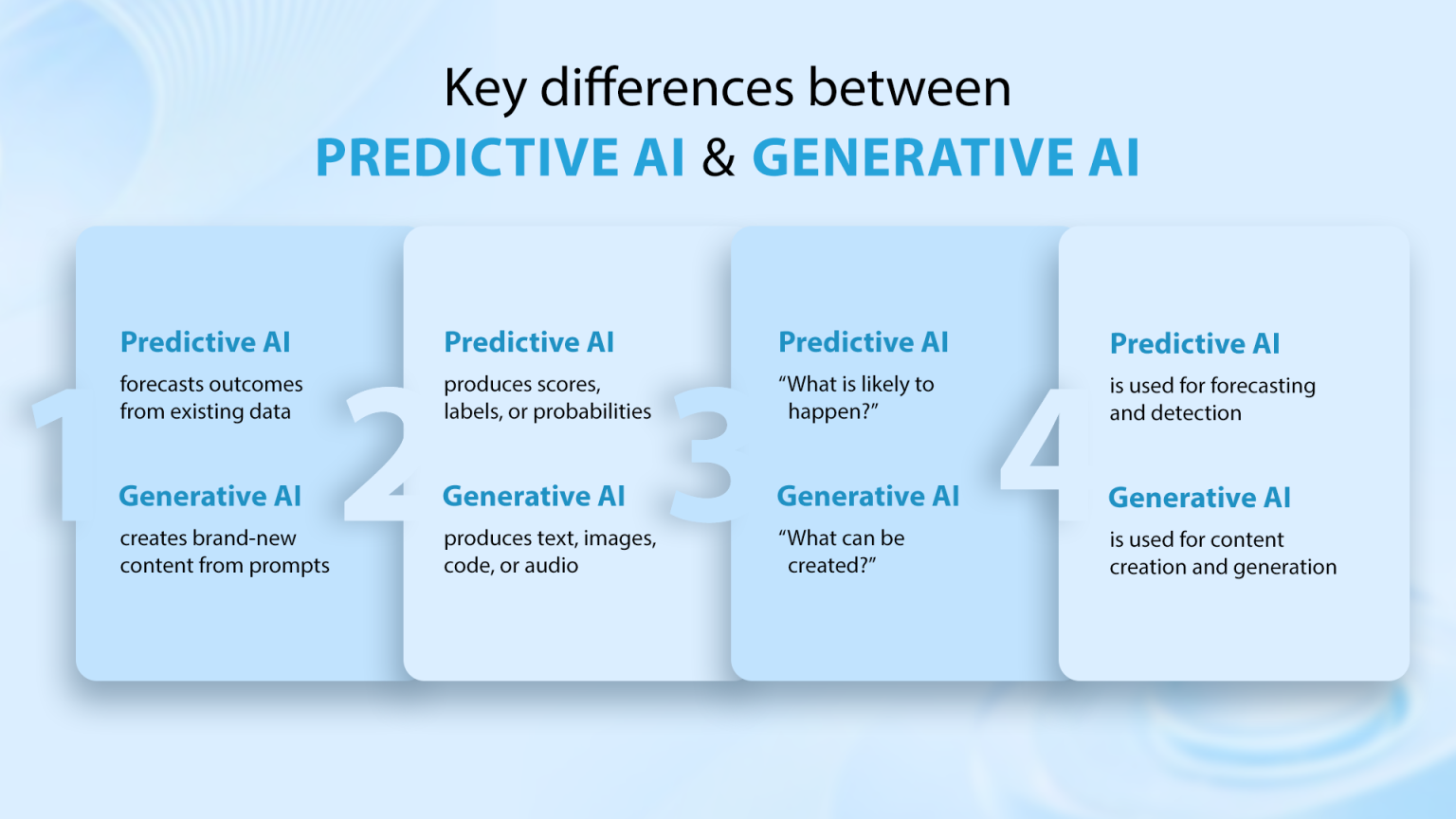
Predictive AI takes existing data and tells you what is likely to happen next. Which customers are about to leave? Does this payment look fraudulent? Which product will this shopper buy next? The output is always a number, a label, or a probability. It has been running quietly inside businesses for over a decade.
Generative AI: the creation engine
Generative AI does not predict. It creates. You give it a prompt, and it produces something new: a contract draft, a product image, a line of code, a customer response, a financial summary. The output is content, not a classification.
Both have their place, and many production systems use both together. A fraud detection system might use predictive AI to flag a suspicious transaction, then use generative AI to draft the analyst report. Understanding the distinction helps you pick the right tool for the job. Our AI chatbot development services operate at exactly this intersection.
How Does a Generative AI Model Actually Work?
You do not need to understand the mathematics to make good decisions about generative AI. But a working mental model helps enormously when you are evaluating tools, talking to engineers, or deciding what to build.
Training
A frontier lab like Anthropic, OpenAI, or Google ingests massive amounts of text, code, and images. The model learns statistical patterns across all of that data. This happens once, at enormous cost. You are not doing this yourself. You are accessing the result of it.
Inference
When you send a prompt, the generative AI model produces a response by predicting what tokens (word fragments) are most likely to follow. This is what you pay for on a per-request basis. Every API call to Claude, GPT, or Gemini is an inference call.
RAG (Retrieval-Augmented Generation)
RAG keeps your private knowledge in a database and pulls the relevant parts into each prompt automatically. Instead of baking your company knowledge into the model itself, you retrieve it on demand. This is the most common production pattern in 2026.
Fine-tuning
Fine-tuning takes a base model and trains it further on your specific data so it behaves the way you want for a particular task. It makes sense for stable, well-defined tasks with lots of high-quality examples. For most use cases, RAG is faster and cheaper.
Agents
An agent wraps the model in a control loop that lets it take actions: search the web, query a database, send an email, call an API, and then respond based on what it finds. Agents are the reason the 2026 conversation has shifted from chatbots to autonomous workflows.
What Are Generative AI Tools?
“Generative AI tools” is the umbrella term for the applications built on top of foundation models. They cover a wide range of categories, and the market has consolidated significantly since 2024.
Text and language tools
ChatGPT, Claude.ai, and Gemini are the consumer-facing products most people have tried. For businesses, the same models are accessed via API and embedded into internal tools, customer-facing products, and workflow automation systems.
Image generation tools
Midjourney, DALL-E, and Adobe Firefly generate images from text prompts. They are now standard in marketing, product design, and advertising workflows.
Code generation tools
GitHub Copilot, Cursor, and Claude Code help engineers write, refactor, debug, and document code faster. The 2026 question for engineering teams is not whether to use AI for coding but how to keep review discipline intact while doing it.
Voice and audio tools
ElevenLabs and similar tools generate realistic voice output from text. They are used in customer support, training, and media production.
Platforms built on these models
A good example from our own work is DeftGPT, an all-in-one AI platform we built for a client that combines content creation, image generation, and team collaboration in a single product. It is built on Claude, OpenAI, and Gemini running via API. Another example is Knowlej, an EdTech platform we built that uses AI to handle attendance, student engagement tracking, and assignment management in one place.
What Can Generative AI Do? Real Use Cases That Are Working Now
The honest answer is: a lot. But the useful answer is more specific. Here are the areas where generative AI is delivering measurable results in 2026.
Customer support and service
Modern AI support systems resolve a significant share of tier-one tickets autonomously, escalate intelligently, and respond in your brand voice. The transition from rules-based chatbots to LLM-powered agents is now standard across industries. See how AI chatbot companies are transforming learning and development as one concrete example of what is possible.
Content creation and marketing
Blog drafts, email sequences, ad copy, product descriptions, and social posts are all areas where generative AI is now standard. The approach that wins is pairing AI output with editorial review. Fully automated content rarely outperforms human-edited AI content.
Financial services
Fraud detection, risk scoring, document automation, and customer onboarding are all live in production at major financial institutions. The ROI here is consistently the strongest of any sector. Our analysis of AI and fintech working together covers the patterns that pay back.
Software engineering
Agentic coding tools are now baseline productivity infrastructure for engineering teams. Engineers using AI tools ship 2 to 3 times more code. The question in 2026 is no longer whether to use AI for development but how to maintain review discipline while doing it.
Healthcare
AI-augmented clinical documentation, imaging diagnostics, predictive deterioration scores, and patient-facing voice agents are all live in regulated environments. Clinical generative AI in 2026 is validated, clinician-supervised, and delivering measurable outcomes.
Education and training
Adaptive learning paths, simulated role-plays, automated scheduling, and personalized content are all in production at schools and universities. As mentioned, 86% of educational organizations now use generative AI.
How to Build a Generative AI Application in 2026
Building with generative AI is more accessible than most people assume. The hard part is not the model. It is everything around it: the right use case, the data layer, the evaluation pipeline, and the integration work.
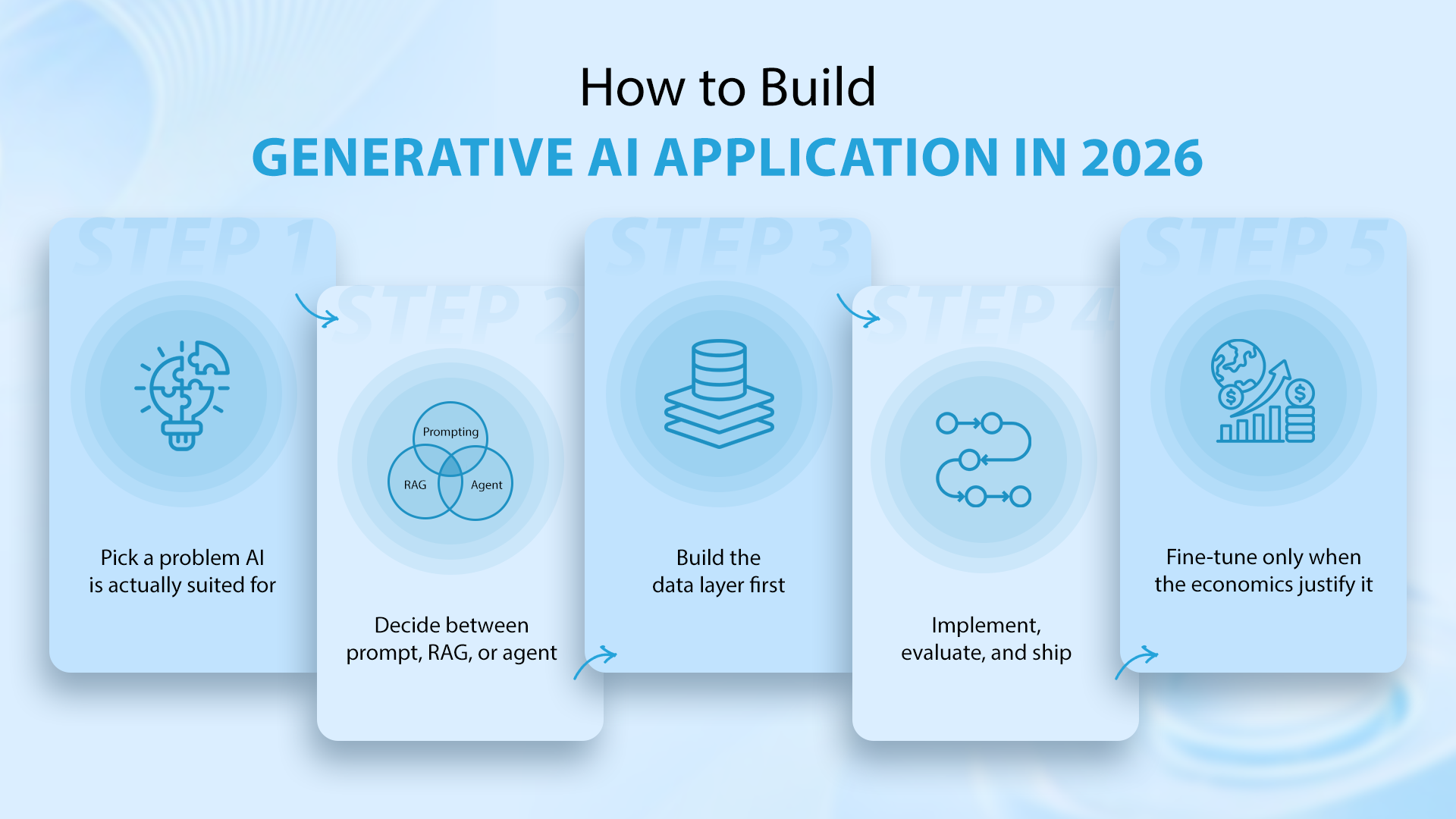
Step 1: Pick a problem generative AI is actually suited for
AI is strong at language pattern matching, summarization, classification, content generation, and structured reasoning over text. It is not suited for tasks where being 90% right is not good enough, tasks requiring real-time state, or tasks where exact arithmetic is required without external tools.
Match the use case to the strength. A lot of failed AI projects begin with a tool in search of a problem.
Step 2: Choose between prompting, RAG, or an agent
A single prompt works when the model has all the context it needs. RAG works when the model needs access to your private knowledge: documentation, product information, support articles. An agent works when the task requires multi-step reasoning, tool use, or autonomous actions.
Start with the simplest approach that solves the problem. Agents are powerful but expensive to build and govern correctly.
Step 3: Build the data layer first
AI quality is bottlenecked by data quality. Many production AI projects stall not on the model but on the data pipeline. RAG systems need clean, fresh, well-structured data. Get the data layer right before worrying about which model to use. Our data engineering practice exists precisely because this is the most common blocker.
Step 4: Implement, evaluate, and ship
Model selection, prompt engineering, structured outputs, evaluation pipelines, deployment, and cost monitoring all need to be in place before you go to production. Shipping without an evaluation pipeline means you are shipping blind. Our step-by-step guide to programming AI covers the implementation flow.
Step 5: Fine-tune only when the economics justify it
For the vast majority of use cases, prompting and RAG outperform fine-tuning. Fine-tuning makes sense when you have a stable task, a large amount of high-quality task-specific examples, and the inference costs favor a smaller specialized model.
Is ChatGPT Generative AI?
Yes. ChatGPT is one product built on top of OpenAI’s GPT family of generative AI models. When you use ChatGPT, you are using a generative AI application.
But generative AI is the broader category. It includes Claude by Anthropic, Gemini by Google, Midjourney for images, ElevenLabs for voice, and hundreds of business applications built on top of these models via API. Treating generative AI and ChatGPT as synonyms is the most common naming error in 2026, and it can lead to narrow thinking about what is actually possible.
A useful way to think about it: ChatGPT is to generative AI what Gmail is to email. One very prominent product within a much larger category.
What Does a Gen AI Company Actually Do?
The term “gen AI company” can mean a few different things. It sometimes refers to the frontier labs building the foundation models, like Anthropic, OpenAI, and Google DeepMind. It sometimes refers to the hundreds of application companies building products on top of those models. And increasingly, it refers to software development companies that help businesses build and deploy generative AI systems inside their own products and workflows.
OCloud Solutions sits in the third category. We build generative AI applications for clients across healthcare, fintech, retail, and enterprise SaaS. We use Claude, OpenAI, Gemini, and LangChain as the foundation and build the data layer, integration layer, and evaluation systems on top.
If you want to understand the broader landscape of what is possible before talking to a development partner, our fun facts about AI piece is a good starting point for getting oriented.
Why Most Generative AI Projects Fail
A measurable share of the AI initiatives launched in the last 18 months stalled before delivering results. The failure modes are consistent enough to be worth naming.
- Picking a tool before defining the workflow. A tool without a baseline workflow has no measurable before and after. You cannot know if AI helped if you did not measure the starting point.
- Treating AI as a side project. Successful AI integration is end to end: process change, tooling, team training, and measurement. Side project AI rarely ships.
- Underinvesting in data and evaluation. No evaluation pipeline means shipping blind. Bad data means bad output. Both are common, both are fixable, and both are root causes for the majority of AI initiatives that did not deliver.
- Signing long contracts with thin wrappers. The 2024 landscape had over 80 AI-for-X startups in every category. Many have been acquired or shut down. Signing a multi-year contract with a product that is simply a wrapper around a frontier model, with no defensible technology underneath it, is a significant risk in 2026.
Frequently Asked Questions
What is generative AI in simple terms?
Generative AI is software that creates new content in response to a prompt. It learned from billions of human-written documents, images, and code samples and can now produce original text, images, audio, and video on demand.
How much does it cost to build a generative AI feature?
A RAG-based knowledge assistant typically costs $30,000 to $120,000 to ship and $500 to $5,000 per month to run. A multi-agent system with deep enterprise integration runs $150,000 to $500,000 and up. Inference costs scale with traffic, and API calls range from fractions of a cent to several cents per request depending on the model.
Should we use a frontier model or an open-source model?
Frontier models like Claude, GPT-5, and Gemini are the right choice for most product features. Quality is highest and time to ship is fastest. Open-source models like Llama and Mistral make sense for data residency requirements, very high-volume inference, or workloads where fine-tuning is critical. Many production systems use both.
Is generative AI safe for regulated industries?
Safe when implemented correctly. Frontier providers offer HIPAA, SOC 2, and ISO 27001-compliant service tiers. Patterns like zero data retention, regional residency, and signed Business Associate Agreements are well established. The risk comes from treating it casually, such as sending protected health information to a consumer-tier API without a data processing agreement in place.
Will generative AI replace developers, marketers, and analysts?
The honest 2026 answer: AI is changing what each role does, not eliminating the roles. Developers ship significantly more code with AI assistance. Marketers manage larger campaigns. Analysts go deeper on complex questions. The roles that are being squeezed are the ones built entirely around tasks AI now automates, such as repetitive content production, basic data summarization, and routine support responses.
Where do I start?
One use case. One team. Ninety days. Measure the baseline, ship, measure the impact, and decide what to scale next. The teams that succeed pick narrow first wins and compound from there. The teams that struggle try to transform everything in year one and lose momentum before they see results.
Related Reading from OCloud Solutions
This guide is the starting point. These blog posts go deeper on specific areas:
- How an AI Chatbot Company Can Revolutionize Learning and Development
- Why AI and FinTech Are the Future of Digital Financial Innovation
- Fun Facts About AI You Cannot Afford to Miss
- Best AI Tools for Business in 2026
- How to Program AI: A Practical Step-by-Step Guide
- DeftGPT Case Study: Building an All-in-One AI Platform
- Knowlej Case Study: AI-Powered EdTech Platform
Ready to Build with Generative AI?
OCloud Solutions builds generative AI applications for clients in healthcare, fintech, retail, and enterprise SaaS. We bring the full stack: model integration, data engineering, evaluation, and the integration work that makes AI features actually useful inside real workflows.
If you are scoping a generative AI initiative for 2026, book a free discovery call with our team.