Model context protocol, or MCP, is the open standard that lets AI applications connect to real time data and tools. If you have searched what is MCP or looked up mcp meaning, you have found a major shift in how AI gets built. This guide breaks down what MCP is and how it works. It also covers why founders, product leaders, and engineering directors care about it.
At OCloud Solutions, we build generative AI and Salesforce Agentforce solutions that rely on this exact kind of connected intelligence. This article explains MCP the way we would explain it to a client on a discovery call. No jargon walls, just a clear picture of what the protocol does.
What Does MCP Stand For?
MCP stands for Model Context Protocol. Anthropic introduced it in November 2024 as an open source standard. It connects AI applications to external systems such as databases, file systems, and business software.
Before MCP, every AI tool needed its own custom connection to every data source. A team supporting ten AI applications and one hundred tools could end up building a thousand separate integrations. MCP replaces that tangle with one shared language. Any compliant AI application and any compliant tool can speak it.
What Is MCP in AI? A Simple Definition
Think of MCP as a universal connector for AI systems. It works a bit like a USB port on a computer. Many different devices can plug into that same port without a custom cable for each one. An AI model on its own can only use the knowledge it was trained on. MCP gives that model a standard way to reach outside its training data.
With MCP, artificial intelligence systems can do far more than answer questions from memory. A properly connected AI assistant can:
- Read files from a company drive or local folder
- Query a live database or customer record system
- Search the web or an internal knowledge base
- Trigger an action, such as updating a record
- Follow a reusable prompt template built for a task
This is what people mean when they call MCP a way to give AI models remote context. The model is no longer isolated. It becomes part of a connected system that can act on fresh, accurate information.
Why Model Context Protocol Matters in 2026
MCP moved from a promising idea to core AI infrastructure faster than almost any open protocol in recent memory. According to Anthropic, MCP reached more than 97 million monthly SDK downloads within one year of release. The protocol also crossed more than 10,000 active public servers in that same period. Client support now spans ChatGPT, Claude, Cursor, Gemini, Microsoft Copilot, and Visual Studio Code. (Source: Anthropic)
That growth pushed Anthropic to hand the protocol to neutral, shared governance. In December 2025, Anthropic donated MCP to the Agentic AI Foundation. This is a directed fund under the Linux Foundation. Anthropic, Block, and OpenAI co founded it, with support from Google, Microsoft, AWS, Cloudflare, and Bloomberg. (Source: Linux Foundation) That is a strong signal for any business leader weighing this standard. Competing AI companies rarely agree on shared infrastructure, and here they have.
For decision makers, the takeaway is simple. MCP is no longer an experimental protocol for hobbyist developers only. It has become the connective layer that major platforms rely on for production AI agents.
How MCP Works: The Architecture Explained
MCP follows a clean structure built around three roles. Understanding these roles makes the rest of the protocol easy to follow.
MCP Host — The host is the AI application the person actually uses. Examples include Claude, an AI powered code editor, or a custom enterprise chatbot. The host manages the conversation and decides when outside information is needed.
MCP Client — An MCP client lives inside the host. It manages one dedicated connection to one MCP server. If a host connects to five tools, it creates five separate client instances, one for each server.
MCP Server — The server is the program that exposes data or capabilities. Examples include a filesystem tool, a CRM, or a search engine. One server can serve many clients at once. Servers can run locally on the same machine or remotely over the internet.
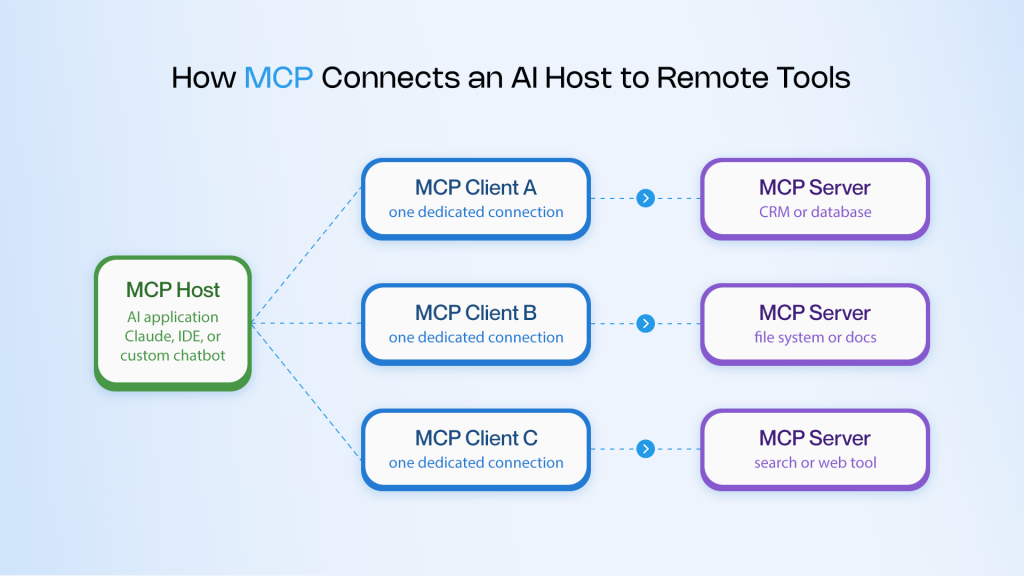
Figure 1. The AI host creates one MCP client for every MCP server it connects to.
When a host application starts, its clients run a quick handshake with each server. This confirms which capabilities are available before any real work begins. From there, the AI model can request tools, pull resources, or apply prompt templates whenever needed. The full exchange usually completes in seconds. That speed is why a connected AI assistant can feel like it already knows things it never trained on.
MCP Client vs MCP Server: What Is the Difference?
This is one of the most common points of confusion for teams new to the protocol. Here is a direct comparison.
| Aspect | MCP Client | MCP Server |
|---|---|---|
| Where it lives | Inside the host application | Runs independently, local or remote |
| Main job | Manages one connection and translates requests | Exposes tools, data, and prompt templates |
| Relationship | One client per server connection | Can serve multiple clients at once |
| Example | The connector inside Claude Desktop | A GitHub server, a Postgres server, a Slack server |
In short, the client is the translator sitting next to the AI model. The server is the specialist holding the actual capability the model needs.
The MCP Protocol Under the Hood
The mcp protocol runs on JSON RPC 2.0. This is a lightweight, well tested messaging format that has powered developer tools for years. Two transport options carry these messages. Local integrations typically use standard input and output. That option is fast because everything runs on one machine with no network overhead. Remote integrations use HTTP based streaming, which lets one server support many users at once.
People often search for MCP as a computing acronym and ask about its performance impact. The honest answer is that MCP adds very little overhead on its own. Recent updates to the specification added caching controls and lighter sessions. These changes let remote servers scale behind ordinary load balancers without slowing responses down. The protocol was built to move context quickly, not to add friction to it.
Real World Example: Context7 MCP
A great way to understand MCP in practice is to look at Context7. It is one of the most widely used MCP servers among developers today.
Context7 mcp solves a very specific and common problem. AI coding assistants often train on older versions of software libraries. That leads them to suggest code referencing outdated or removed functions. The context7-mcp server fixes this by fetching current, version specific documentation from the source. It places that documentation directly into the AI model’s context before it writes any code.
A developer using an MCP capable editor can add a phrase like “use context7” to a prompt. The assistant then retrieves accurate, current documentation instead of guessing from memory. This example shows exactly why MCP artificial intelligence tools are gaining traction. The model becomes more accurate the moment it reaches real, current information.
Some teams want to connect a language model to MCP servers with code, not a chat app. An open source library called mcp-use has become popular for that. It lets developers connect almost any large language model to any MCP server. This avoids vendor lock in, which is useful for custom agent development.
MCP vs Traditional API Integrations
Before MCP, connecting an AI system to multiple tools created what engineers call the N by M problem. Every AI application needed a custom integration for every tool it used. The number of connections grew fast as either side added new tools or new models.
MCP turns that multiplying problem into a simple, additive one. Each tool builds one MCP server. Each AI application builds one MCP client capability. Any compliant application can then use any compliant server without new custom code.
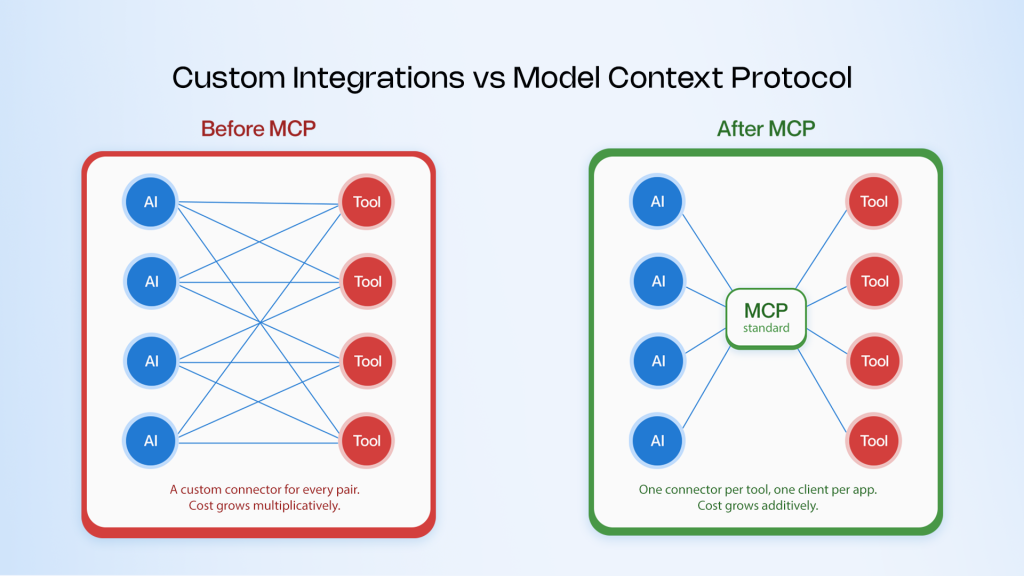
Figure 2. MCP replaces the tangled N by M integration problem with one shared standard.
| Traditional API Integration | Model Context Protocol |
|---|---|
| Custom connector per tool, per application | One standard connector shared across tools |
| Integration cost grows multiplicatively | Integration cost grows additively |
| Switching AI vendors often means rebuilding integrations | Tools stay usable across different AI vendors |
| No shared discovery mechanism | Built in capability discovery at connection time |
Business Benefits of MCP for Decision Makers
For founders and product leaders evaluating AI budget, MCP offers a few concrete advantages worth weighing.
- Lower integration cost. Teams build one server per system instead of a separate connector for every AI tool that needs it.
- Vendor flexibility. MCP is model agnostic, so a business can add AI providers without rebuilding its integration layer.
- Faster agent deployment. Teams can plug existing MCP servers into new AI products instead of writing new integration code.
- Stronger governance. MCP now sits under the Linux Foundation’s Agentic AI Foundation, with vendor neutral oversight rather than single company control.
- Better data freshness. AI systems can query live data at the moment of use, rather than relying only on outdated training knowledge.
These benefits explain why MCP now shapes how businesses evaluate AI agent platforms. Our earlier piece looks at how Salesforce Agentforce compares to older, more rigid chatbot tools. It covers why connected, action taking AI is replacing static automation.
Security and Governance Considerations
Connecting AI models to live systems brings real responsibility. Any team adopting MCP should plan for it early. A few practices matter most.
- Grant the smallest possible set of permissions to each MCP server connection.
- Require explicit user approval before an agent takes a sensitive action.
- Log every tool call for auditing, especially in regulated industries.
- Use authenticated, encrypted transport for any remote MCP server.
- Review third party MCP servers before connecting them, just as you would review any new vendor.
The specification has matured quickly on this front. Newer releases formalize authorization patterns closer to the standard OAuth flows already used across the software industry.
How OCloud Solutions Helps You Adopt MCP and Agentforce
Understanding MCP is the first step. Turning it into a working, secure part of your business systems is where most teams need support. Our Salesforce development and Agentforce services help businesses design AI agents that connect safely to CRM data and internal systems. We build on this same protocol driven approach.
If you are still building the case for generative AI at your organization, start with our guide on what generative AI is and how it applies to real business problems. It is a useful primer before you dive into protocol level detail like MCP.
Frequently Asked Questions
What does MCP stand for?
MCP stands for Model Context Protocol. Anthropic created it as an open standard for connecting AI applications to external tools and data sources.
What is MCP in AI, in one sentence?
MCP is a standardized way for AI models to discover and use outside tools, files, and live data, instead of relying only on training knowledge.
Is MCP the same thing as an API?
Not exactly. An API is a general way for software to talk to other software. MCP is a specific protocol built for how AI models discover and call tools consistently.
What is an MCP client, in simple terms?
An MCP client is the connector piece inside an AI application, such as Claude Desktop, that manages the link to one specific MCP server.
What is Context7 MCP used for?
Context7 mcp is a server that fetches current, version specific documentation for software libraries. It delivers that documentation directly into an AI coding assistant’s context.
What is mcp-use?
Mcp-use is an open source Python and TypeScript library. It lets developers connect almost any large language model to any MCP server for custom agent building.
Does MCP slow down AI performance?
There is no meaningful slowdown in normal use. MCP was built to be lightweight, and recent spec updates added caching to keep remote servers fast at scale.
Is MCP secure enough for enterprise use?
It can be, with the right setup. Enterprises should apply least privilege access, require approval for sensitive actions, log activity, and use encrypted connections.
Final Thoughts
Model context protocol has moved from a clever internal fix at one AI company to shared infrastructure most major AI platforms now build on. For any business exploring AI agents, from customer service automation to Salesforce Agentforce deployments, understanding MCP matters. It is the layer that determines how reliably your AI systems reach the data and tools your business runs on.
If your team is ready to explore a protocol driven, connected AI strategy, OCloud Solutions can help. We can scope the right approach starting with your first conversation.